High School Girl Life Sim 3D
- 4.3
- Rating
- 10.00M
- Installs
- Free
- Price

 Analysis by App-foxy
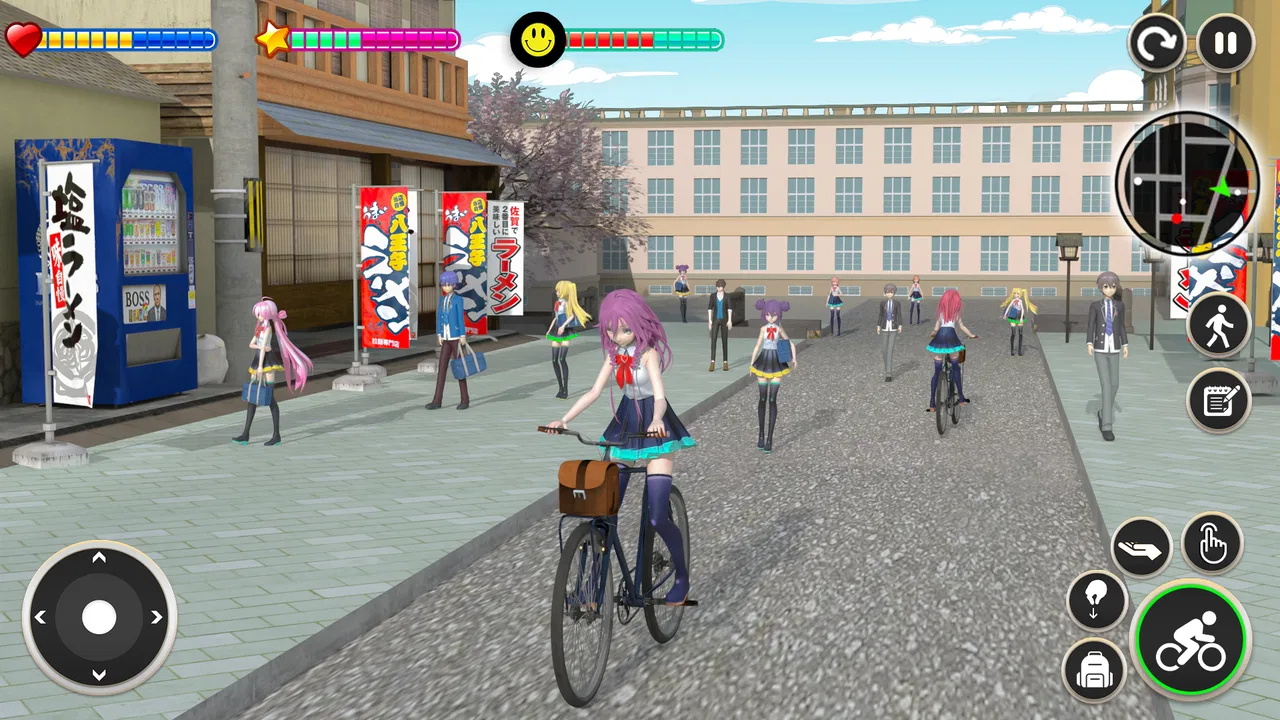
High School Girl Life Sim 3D is a role-playing game from Virtual Entertainment Studio that puts me in the middle of an anime-styled school life. I play as a schoolgirl, move through a three-dimensional campus setting, and make the experience feel more like a casual character simulator than a story-heavy role-playing adventure. That distinction matters: I enjoyed it most when I treated it as a light, open-ended break rather than expecting a deep campaign with carefully written quests.
The game is free to download and aimed at Teen players. It works on devices running Android 6.0 or later, and the current version is 2.8.7. It has been available since July 5, 2021, and its audience is substantial, with more than ten million installs and an average score of 4.3 from roughly thirty-nine thousand ratings. Those figures suggest that the basic idea has broad appeal, although they do not replace personal testing: school simulators can feel entertaining to one player and repetitive to another very quickly.
What the school-life role-playing format feels like
My first impression was that the appeal comes from inhabiting an anime school setting rather than chasing a complicated objective. The familiar school backdrop gives the game an immediately understandable identity. I do not need to learn a fantasy world, memorize a large cast, or understand a complex combat system before I can enjoy the premise. The simple fantasy is clear: become an anime girl, attend a high-school-style environment, and see what happens as I move around and interact with the world.
You May Also Like

 Blood Strike: 2.5 Anniversary
Blood Strike’s Loadouts Turn Every Drop Into a Tactical Gamble
A close look at Blood Strike’s custom loadouts: how fast access to signature weapons reshapes its battle royale rhythm, rewards preparation, and narrows the gap between fights.

 Pandora - Music & Podcasts
Pandora’s Music Is Easy to Start, but Harder to Recover
Pandora’s strength is its low-effort path from a seed to a station. Its weak spot is how much confidence it asks you to place in connection, setup, and quiet recovery.

 8 Ball Pool
 Is Built on Rivalries, Rematches, and Routine
A close look at the rivalries, rematches, shared routines, and unanswered safety questions that turn a quick pool match into a persistent mobile community.

 Samsung Music
’s Quiet Strength Is Playing What You Already Own
Its reach comes less from spectacle than from dependable access to a personal library. That simplicity is both the app’s strongest retention engine and its ceiling.

 AccuWeather: Weather Radar
AccuWeather Review: A Quick, Clear Forecast for Everyday Decisions
For everyday plans, the best forecast is the one you can understand quickly. AccuWeather makes rain timing, radar, and local conditions easy to act on, with a few trade-offs.

 Hill Climb Racing
Why Hill Climb Racing Still Turns Crashes Into One More Run
A tiny car, a bumpy hill and one more upgrade: Hill Climb Racing keeps resurfacing because its simple chaos makes every near-miss feel personal.
More From Our News Desk
View All News


That makes it a comfortable choice for short sessions. I can open it when I have a few spare minutes, explore the setting, and stop without feeling that I have abandoned an important plot thread. It also suits players who like avatar-based games and anime presentation but are not looking for a demanding strategy experience. The role-playing label here is best understood as a character-and-world simulation style, not as a traditional numbers-heavy adventure.
The three-dimensional presentation is important because the school environment is something I experience through movement, not just menus. Wandering around gives the game a stronger sense of presence than a simple dialogue simulator. At the same time, this format places more responsibility on the environment itself. If the surroundings and available activities do not keep my attention, the freedom can start to feel like empty space rather than meaningful choice.
A useful way to approach the opening sessions
I recommend spending the first session learning the layout instead of rushing to repeat the same actions. In a school simulator, knowing where I am going makes later play feel smoother. I pay attention to recognizable areas, notice how the character responds to the environment, and test the basic movement at a relaxed pace. This is a more rewarding approach than immediately judging the game by whether it has the dramatic momentum of a conventional role-playing title.
Another practical tip is to decide what kind of session I want before opening it. If I want a calm bit of exploration, I can focus on the school-life fantasy. If I want constant rewards, intense battles, or a strong narrative hook, I should recognize that this may not be the right kind of game for that mood. The game works better when I accept its slower, more observational rhythm.
That rhythm also explains why the short description, “High School Girl Sim,” is more useful than a grander interpretation. It sets a modest expectation. I am not buying into an enormous role-playing journey; I am trying a school-life simulation with anime styling. Keeping that expectation in place makes the experience easier to appreciate.
Progress can feel personal rather than competitive
One of the more interesting trade-offs is that progress in this kind of game is often measured by how comfortable I become with the setting and routine, not only by a visible power increase. I may feel that I am getting more value from the game because I understand how to spend a session, where to go, and which activities fit my preferred play style. That is a different kind of progression from leveling up a character to defeat stronger enemies.
The downside is that players who need a clear chain of objectives may feel under-directed. When a game is built around a school-life fantasy, freedom can become a strength or a weakness depending on what I expect. I found it more satisfying when I created small personal goals, such as exploring a different part of the campus or changing the way I approached a session, rather than waiting for the game to provide a constant stream of major milestones.
This is also where repetition can become noticeable. A simulator depends on its setting remaining pleasant over time. If I enjoy simply being in that anime school world, returning feels natural. If I need fresh mechanics every few minutes, the same freedom may feel less exciting. I would therefore treat it as a game for relaxed recurring visits, not as a single uninterrupted marathon.
Spending, fairness, and what I would check before committing
Because the game is free, the first financial advantage is obvious: I can try the core experience without paying an entry fee. That makes it easier to decide whether the school-simulator format suits me. I would still approach any free mobile game with sensible caution around optional spending, especially if I were installing it for a younger player. The Teen content rating is a useful reminder that this is not positioned as a preschool title.
I do not treat the free label as proof that every part of the experience is equally accessible. A free download can be generous, restrictive, or somewhere in between, and the practical question is whether spending changes convenience, appearance, progress, or competitive ability. I would make that judgment from the purchase information shown in the app at the time of use rather than assuming a particular monetization model.
For me, the important fairness test is simple: can I enjoy the school-life fantasy without feeling pushed toward payment? If optional purchases merely shorten waiting or add customization, that is a different situation from purchases that determine who can progress or perform best. High School Girl Life Sim 3D is primarily a personal simulation experience, so competitive pressure should not be the main reason to install it. Still, I would look carefully at any purchase prompts before spending and avoid buying anything impulsively during a first session.
Why competitive players may want a different game
This is not the title I would choose when fairness means ranked competition, carefully balanced character builds, or skill-based matches. Its appeal is the anime school setting and the feeling of controlling a character in that world. A player searching for esports-style balance, multiplayer rivalry, or transparent competitive progression would probably be better served by a game designed specifically around those goals.
That is not necessarily a flaw. A quiet single-player-style simulator does not need the same systems as a competitive role-playing game. The trade-off is that the rewards of play are more subjective. I get enjoyment from exploration, atmosphere, and the small decisions I make during a session, while another player may see the same design as lacking urgency. The right choice depends on whether I want a world to inhabit or a contest to master.
A concrete everyday use case is a short evening break after work or school. I might have enough time to play but not enough energy to follow a complicated story or manage a demanding team. In that situation, the school setting and straightforward premise are convenient. I can spend a little time exploring and then put the phone down. If I instead have a long commute and want a game with constant tactical decisions, a more structured role-playing alternative would likely hold my attention better.
Device expectations and practical patience
The minimum operating-system requirement is Android 6.0, which makes the game available to a wide range of older compatible devices. That does not guarantee identical performance on every phone. Three-dimensional games can feel different depending on hardware, screen size, and how smoothly movement responds. I would install it with reasonable expectations, especially on an older device, and give myself time to decide whether the controls and presentation feel comfortable.
I also recommend keeping the first impression separate from the long-term judgment. A school simulator may seem simple at first because the premise is immediately familiar. Its value becomes clearer after I try different ways of using the environment. Conversely, if the basic movement and atmosphere do not feel enjoyable early on, I would not expect the game to become a completely different type of experience later.
The version number, 2.8.7, identifies the current release I would look for when installing. Keeping the app updated is generally sensible for access to the latest available build, but I would not assume that a version label alone guarantees a particular improvement. My decision would remain based on how well the game fits my preferred pace and device.
Who should install it, and who should skip it?
I would recommend it to players who like anime-inspired school settings, casual role-playing, and the idea of spending time inside a character simulator without needing a dramatic campaign. It is especially approachable for someone who wants a free trial of the format and prefers flexible sessions. The large install base and strong average rating show that the concept has found an audience, though personal taste still matters more than popularity for a game this focused.
I would be more cautious about recommending it to players who want elaborate storytelling, deep character statistics, challenging combat, or a carefully escalating progression system. I would also skip it if I were specifically searching for a competitive game where every purchase and upgrade can be evaluated through ranked performance. The school-life premise is the center of attention, so players who find that premise uninteresting may run out of reasons to return.
Parents should also consider the Teen rating before allowing a younger child to play. I would review the in-app experience personally and discuss spending boundaries in advance. Setting a rule not to make purchases without permission is more useful than assuming that a free download has no financial implications.
The unanswered questions I would resolve through cautious use
One question many players will have is whether the game remains enjoyable after the novelty of the school setting fades. My answer is conditional: it depends on whether exploration and character simulation are enough to keep you engaged. I would give it several short sessions rather than one long test. That reveals whether the environment supports a routine I actually enjoy or whether the initial anime presentation was doing all the work.
Another question is whether it is suitable for playing offline or during travel. I would not plan around that unless the app itself clearly indicates the required connection behavior. For a trip, I would test it before leaving rather than discovering that a necessary feature does not work in the situation I had planned. This small precaution matters more than guessing from the game’s genre.
Players may also wonder whether progress carries over safely between devices. I would avoid assuming that it does. Before changing phones or reinstalling, I would check the in-game account and save options carefully and make sure I understand what is connected to the device. That is a practical habit for any mobile game, but it is especially important when progress is based on time spent exploring a personal simulation.
Finally, I would ask whether the game is worth keeping installed if I only play occasionally. For me, the answer is yes when I want a low-pressure anime school experience and the app runs comfortably. If I am not returning because the activities feel repetitive, uninstalling is reasonable; the free price removes the need to justify keeping it purely as a purchase.
My trust verdict after weighing the trade-offs
High School Girl Life Sim 3D succeeds by being clear about its central fantasy: I become an anime schoolgirl and spend time in a high-school-style three-dimensional world. Virtual Entertainment Studio has made a game that is easy to understand, free to try, and broad enough to attract a large mobile audience. I appreciate that I can approach it casually instead of treating every session as a serious campaign.
My reservation is equally clear. The game’s freedom can feel thin if I need constant objectives, and the school setting will not appeal to everyone for the long term. I would also make spending decisions carefully, because the free entry point should not be confused with a guarantee that every optional part of a mobile game is equally valuable. For competitive fairness, I would choose a purpose-built multiplayer title instead.
My recommendation is to try it with modest expectations and a clear spending boundary. If the anime school atmosphere, relaxed exploration, and character-simulation angle sound enjoyable, it is an accessible role-playing game to test without an upfront cost. If you want deep narrative, demanding strategy, or competitive progression, look elsewhere. For the right player, it is a pleasant casual escape; for the wrong one, its open-ended simplicity will feel more like a limitation than freedom.
FAQs for High School Girl Life Sim 3D
01What is High School Girl Life Sim 3D about?
High School Girl Life Sim 3D is a simulation game where you step into the shoes of a high school girl navigating daily life. You'll experience tasks such as attending classes, participating in extracurricular activities, and building friendships. The game offers a realistic portrayal of high school life, complete with challenges and social interactions.
02Is High School Girl Life Sim 3D free to play?
Yes, High School Girl Life Sim 3D is free to download and play. However, it may include in-app purchases that offer additional features or content. These purchases can enhance the gameplay experience, but they are entirely optional, allowing players to enjoy the core game without spending money.
03What are the main features of High School Girl Life Sim 3D?
The game features a detailed 3D environment where players can explore a virtual high school. Key features include customizable characters, interactive dialogue options, various mini-games, and a storyline that evolves based on player choices. These elements combine to create an engaging and immersive experience.
04Can I play High School Girl Life Sim 3D offline?
High School Girl Life Sim 3D requires an internet connection for initial download and updates. Once installed, certain features of the game can be played offline; however, some functionalities, such as social interactions or additional downloads, may require connectivity to fully enjoy the game.
05What age group is High School Girl Life Sim 3D suitable for?
The game is best suited for teenagers and young adults, particularly those interested in simulation games. It includes themes of high school life that may not be suitable for younger children. Parents might want to review the game content to ensure it aligns with their values and expectations.
Pros
- Immersive 3D environments enhance gameplay.
- Diverse character customization options.
- Engaging storyline with multiple quests.
- Smooth controls for easy navigation.
- Regular updates with new features.
Cons
- In-app purchases can be costly.
- Occasional glitches disrupt gameplay.
- Ads may interrupt the experience.
- Limited offline functionality.
- Requires a high-performance device.

High School Girl Life Sim 3D
Gallery